
Formality Out, Meadow In
A Gilded Age Southern Garden Transformed Through a Design Process That Works Anywhere

Transforming a Gilded Age Garden: From Formal to Free-Flowing
“This garden is full of joy,” she said on her first visit to my Momma’s place. “I love it. Mine has no flowers, no joy.” She sighed, then asked, “Can you help me?”
Turns out, she was right about lacking joy. But on my first visit, I couldn’t answer her huge question - Could I help her?
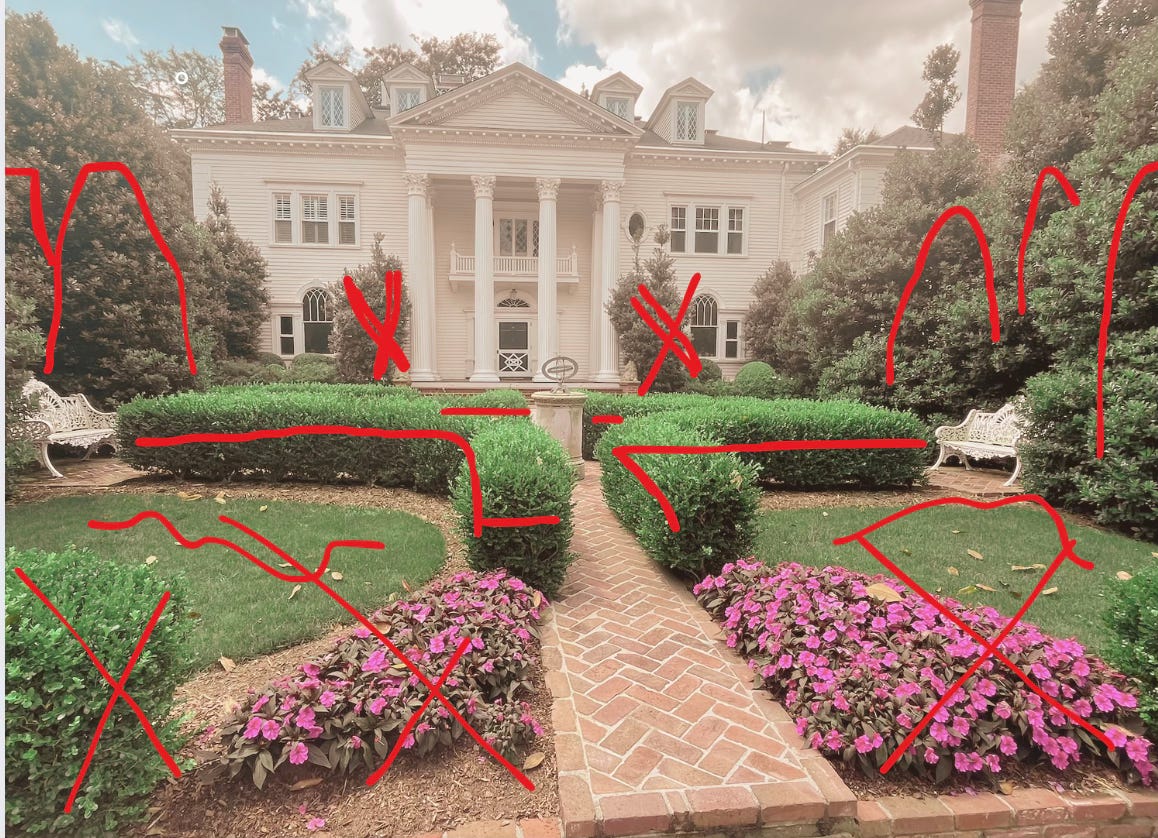
She wasn’t there on the day I stopped by, so I didn’t have to say or try to hid exactly what I thought. The stately house hid behind glowering bushes. The overgrown entry courtyard failed to match the architecture. Think balloon-arch-at-high-school-prom. The house was stunning. The plants were dowdy. There were actually a few flowers: purple sunpatiens straight off the home despot truck.
Not only did I not see joy, but I saw oppression and domination. I gritted my teeth and took notes.
Evaluating Garden Problems: Scale, Proportion, and Design
Later, at my stand-up drawing desk in the barn loft, I marked up the problems in red. The problems list included:
Plants grown way out of scale
Improperly placed huge shrubs impeded views from and to the house
Proportions out of sync; plant to plant, and garden to house.
Bland color beds for seasonal interest.
No consideration of long views or overall picture
Sending a message of domination
Without major changes, adding flowers wouldn’t be satisfying—not to me. Not to her either. Flowers would be a band-aid- the kind that doesn’t stick. But how should I tell a client who asked for ‘some flowers’ that the entire structure is wrong? I remembered her word - joy. I could offer solutions. that brought joy.
Still, she’d asked for some flowers, and here I was proposing major design renovations. I worried I’d lose this job.
Turns out, she had felt these things too. She understood architecture and design. I simply put her garden’s issues into words. After my proposal, she asked a few questions, she surprised me by quickly saying, “Do it.” Then she surprised me again with her plant knowledge when she added, “If you can, use lots of plants from Woodlanders.” Woodlanders Nursery is one of those places that real plant-people know on a first-name basis.
Planning and design work, including identifying problems, evaluating scale and proportion, creating lists and solutions, is expanded upon in my new book, Secrets of Southern Gardening. There are case studies ranging from a simple brick bungalow and an elaborate Bauhaus-inspired house on the coast. The design chapter demonstrates how design and landscape evaluation works the same way for any size space or budget, whether you’re working on a Gilded Age estate or a small city lot.
Historic Sandhurst House and Woodlanders Nursery
Her house in Aiken is called Sandhurst and was built in 1900, designed by Hoppen and Koen, protégés of Stanford White who was the Gilded Age architect. They worked mostly in New York and Newport, designing the sorts of houses featured in recent episodes of the tv drama called, The Gilded Age. That time is also known as the golden age of American gardens. The flowery, joyful garden she dreamed of should have been here all along. Though I’ll do a modern take on a meadow-like flower garden, it’s rooted in horticultural history.
Woodlanders Nursery, also in Aiken, is an internationally recognized old-school mail-order nursery. For decades, you could hardly get your foot in their door, but the new owner is shaking things up and bringing new life to it in the modern world. Now they have open days, an email address, and are even on Instagram! (Fall Open Day is this Saturday October 18. — FYI Don’t leave without their plumb colored Beauty Berry, Walter’s Pine, Carolina aster, and ‘Pale Yellow’ Carolina Jessamine.)
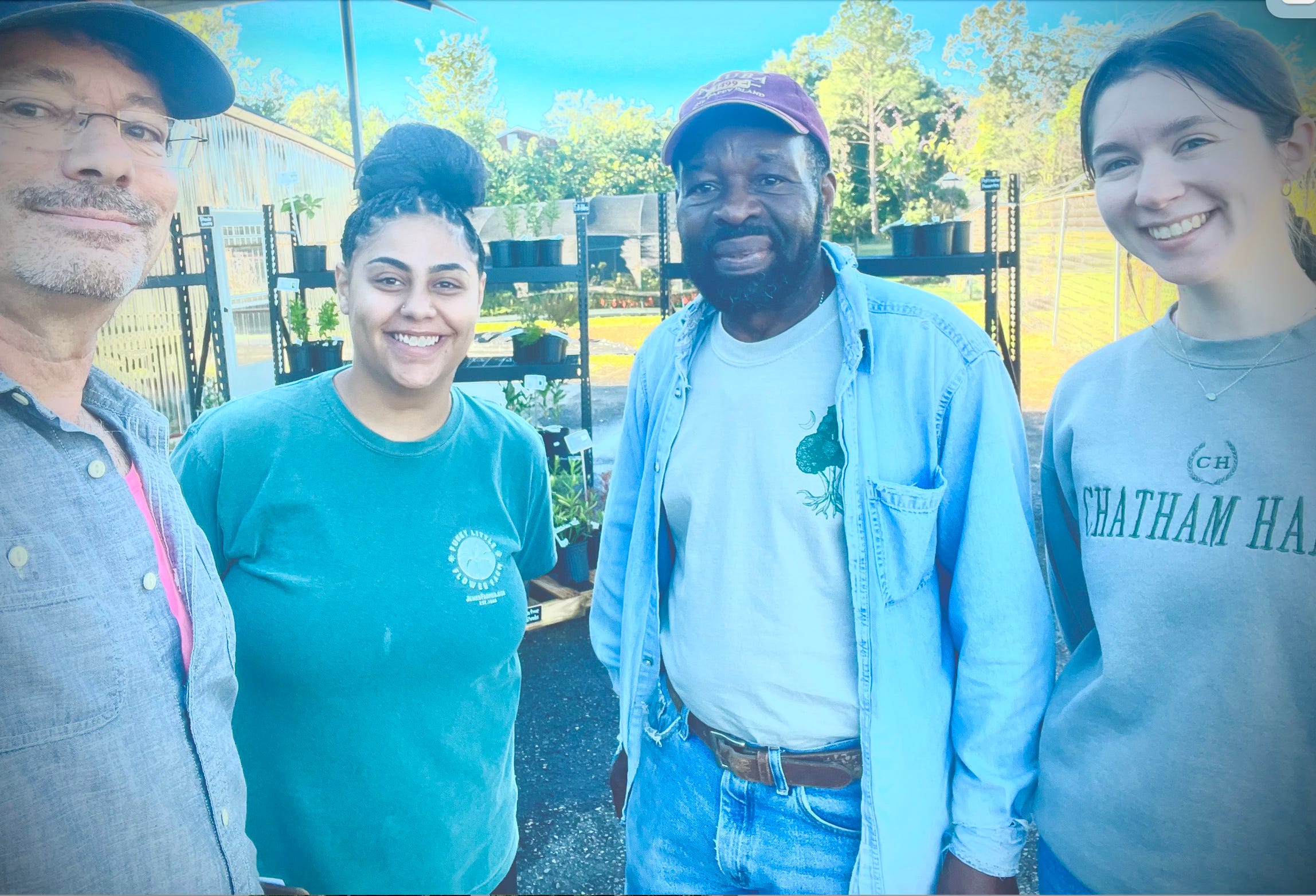
I love being a part of projects that build on local history but aren’t afraid to acknowledge and dismantle problematic parts of the past or make bold statements about who we are and how we should garden and live today. I love that this white-columned house is now being given a modern makeover by our diverse team.
Garden Renovation Process: Summer Work
Over the summer, we addressed three major issues.
First, we pulled out lots of overgrown plants - massive Limelight hydrangeas and hollies, about ⅓ of the bothersome boxwood hedge. And we sprayed out all of the turf.
Second, to address proportion, we hat-racked some of the large hollies, cutting them back to bare wood and did serious rejuvenation pruning on others. It looked terrible.
Third, we planted my vision for a focal point following the sightline from the house, across the garden, into the woods: three massive, 2-year-rejuvenated palmettos.


Planting a Southern Perennial Border with Native Plants
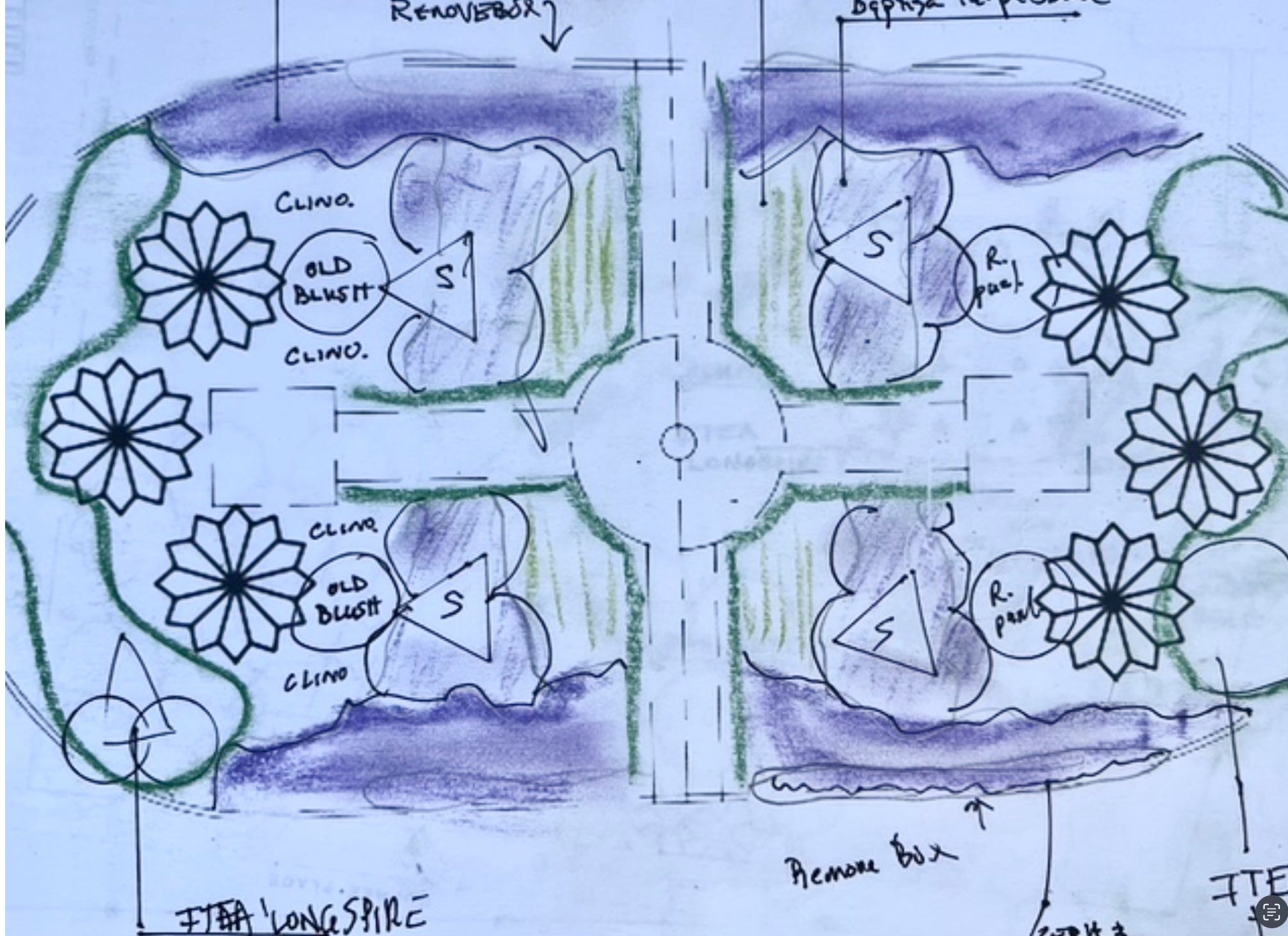
This fall, we’re finishing the perennial border. Starting with Woodlanders’ favorites, we’ve gathered and planted true Southern performers, including:
Clinopodium ‘Desi Arnes’, aka Georgia savory. It’s an 18-inch shrublet with tiny, fragrant, glossy leaves and masses of lavender flowers in the fall.
Aster ‘Raydon’s Favorite’ and Salvia lyrata (a combo that gives spring, then fall color)
Phlox pilosa ‘Eco Happy Traveler’ and Rain Lily (a favorite spring combo)
Carolina Jessamine ‘Woodlanders Pale Yellow’ and Itea ‘Longspire’ (both Woodlanders selections).
Mixed in with all of that are bulbs like Southern Snowflake and jonquils. Finally, we’ll overseed with winter-growing annuals like larkspur and toadflax. (In Sunday’s substack, I’ll offer up my top ten, no fail, full of joy bulbs for the Deep South.)
She was inspired by Momma’s country garden, and I’m inspired to show that you can have a free-flowing, rambunctious flower garden where some folks expected only boring formality. I’m thrilled to be building in and around the old guard while creating new joy.
In the spring, I’ll share photos of the flowers and joy!
Oh, I love this way of showing before and afters — I can't wait to see what you turn it into! It's also so interesting to hear your thoughts on how landscaping can complement (or insult) architecture. I've never given that much thought, except for perhaps the recent destruction of the Rose Garden at 1600 Penn Ave in favor of ... whatever atrocity that concrete pad is.
I have enjoyed the informality of a perennial border or meadow since childhood. I always have looked forward to the mystery of what lies around the next corner. It gives us a chance to slow down in a fast-paced work-a-day world and take it all in.